
Inclusion
Pilgrims’ Way Primary school prides itself on being an inclusive and diverse primary school which teaches pupils from the ages of 3-11.

We value each pupil’s uniqueness, and their differences are recognised and celebrated.
At Pilgrims' Way, inclusion is at the heart of everything we do. We recognise, respect and celebrate every child's individuality and believe that all children should feel valued, supported and successful, regardless of their background, ability, language, experiences or starting point.
We are committed to identifying and removing barriers to learning so that every child can participate fully in school life, develop confidence and reach their potential.
Through this commitment, we strive to ensure that every child can Belong, Believe and Achieve.
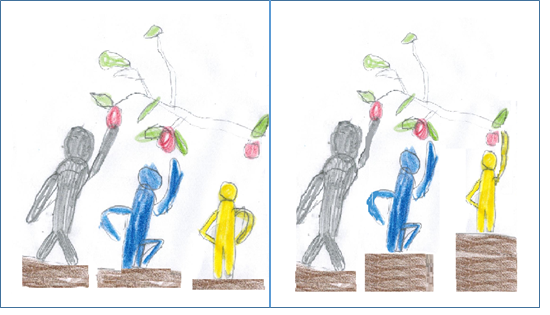
It's not about pupils getting the same. It's about pupils getting what they need!
Belong
We create welcoming environments where children feel safe, respected, understood and valued. Through positive relationships, strong partnerships with families and a culture of acceptance, every child is supported to develop a genuine sense of belonging within our school community. We celebrate individual strengths, identities, experiences and cultures, helping pupils build confidence, wellbeing and positive relationships.
As part of our inclusive provision, Pilgrims' Way has an on-site Inclusion Base comprising The Meadow and The Willow. This school-funded provision supports pupils on roll at Pilgrims' Way whose needs require a more personalised and specialist approach within a mainstream setting.
Access to the Inclusion Base is determined through a collaborative process involving school leaders, parents/carers and, where appropriate, the pupil. Decisions are based on individual need and reviewed regularly to ensure provision remains effective, appropriate and responsive to each pupil's development.
The Meadow provides a highly individualised Engagement Curriculum for pupils with complex and long-term special educational needs and disabilities (SEND). Through specialist teaching, adapted learning approaches and personalised support, pupils develop communication, engagement, independence and readiness for learning. Many pupils have an Education, Health and Care Plan (EHCP) and require significant support with communication and interaction. Where appropriate, pupils access learning and experiences alongside their mainstream peers, maintaining meaningful connections to the wider school community.
The Willow provides targeted specialist support while enabling pupils to remain fully involved in mainstream classes and school life. It supports a range of needs, including communication and interaction, cognition and learning, social, emotional and mental health needs, sensory processing differences and other neurodivergent profiles. Through personalised support, reasonable adjustments and specialist interventions, pupils are supported to engage, participate and flourish in school.
Together, these provisions are central to our inclusive ethos, ensuring every pupil receives the support they need to thrive as a valued member of our school community.
Believe
We have high expectations for every child and are committed to helping pupils develop confidence in themselves and their abilities. We encourage every child to develop self-belief, knowing that their voice matters and that they can achieve meaningful outcomes.
Achieve
We are ambitious for all pupils and recognise that success looks different for every learner. We celebrate progress in all its forms and work to ensure that every child is well-prepared for the next stage of education and for life outside of school.
What Inclusive Practice Looks Like Every Day
Inclusive practice is how we bring our vision to life through the decisions we make, the relationships we build and the way we teach.
Our universal offer is built upon high-quality teaching, a curriculum designed for all learners and a safe, respectful school culture. It supports every pupil, including those with Special Educational Needs and Disabilities (SEND), social, emotional and mental health needs, bilingual and multilingual learners, disadvantaged pupils, young carers and those requiring additional challenge.
This includes:
-
Planning learning that enables all pupils to participate, engage and experience success
-
Using evidence-informed approaches such as scaffolding, modelling, chunking and flexible grouping
-
Listening to and valuing pupil voice to understand what helps children learn and thrive
-
Identifying barriers to learning early and responding promptly
-
Continually developing staff expertise to meet a wide range of needs
-
Working closely with families and external professionals to provide coordinated support
Language and communication are central to learning across the curriculum. We explicitly develop pupils' vocabulary, oracy, literacy and understanding so that they can access both the social and academic language needed for success.
Where appropriate, some pupils may access carefully planned interventions or short-term provision outside the classroom, such as Forest School, Drawing and Talking, or speech and language support. These interventions are designed to complement and strengthen classroom learning rather than replace it.
Inclusion is a shared responsibility. We work in partnership with pupils, families, staff, governors and external professionals to ensure inclusion remains visible, meaningful and embedded throughout every aspect of school life and pupils receive the help they need.
Meet Our Inclusion Team
Our Inclusion Team provides additional expertise and support for children, families and staff.
Mrs Walsh leads support for Speech, Language and Communication Needs (SLCN). She provides targeted and specialist intervention where appropriate and supports staff to embed effective communication strategies across the school.
Helen (Family Liaison Officer), Mr Walsh (Forest School Lead) and Mrs Anderson (Emotional Literacy Support Assistant) support pupils' social, emotional and mental health needs.
Mrs Talbot and Mr Cheatham teach within our Inclusion Bases, The Meadow and The Willow.
Mrs Smith, SENCo, provides advice and guidance regarding Autism, ADHD and referrals to external agencies. She can be contacted at: zara.smith@pilgrims-way.kent
Mrs Watts, Inclusion Lead and SENCo, is available to discuss any concerns, questions or support needs. She can be contacted via the school office or at: olivia.watts@pilgrims-way.kent
Please click on the links on the right for further information on Special Educational Needs and Disabilities (SEND), Bilingual and Multilingual Learners and Young Carers.
Mainstream Core Standards
The Mainstream Core Standards
The Mainstream Core Standards guide for parents
Supporting, speech, language and communication (SLC) at Pilgrims' Way
At Pilgrims' Way, we understand how important speech, language, and communication skills are for every child’s learning, emotional wellbeing, and social development. These skills are the building blocks for success at school and beyond — helping children to build friendships, express their needs, and achieve their potential.
What is speech, language and communication?
-
Speech is the act of producing sounds that form words, allowing us to communicate verbally. It involves the physical process of using our vocal cords, mouth, and breath.
-
Language is the words and grammar used to communicate. It's how we express thoughts, ideas, and emotions, whether spoken, written, or signed.
-
Communication is the process of sharing information, thoughts, and feelings between people. It can be verbal (speech), non-verbal (gestures, facial expressions), written, or visual.
What types of difficulty can children have?
-
There are many different types of speech, language and communication needs (SLCN). Some examples are:
-
Difficulties understanding language: Such as struggling to follow instructions, or understanding what words mean.
-
Expressive language difficulties: Difficulty using language to communicate.
-
Speech sound disorders: Difficulty producing speech sounds correctly.
-
Stammering (Stuttering): Disruptions in the flow of speech.
-
Social Communication Difficulties: Challenges with using language in social contexts, such as understanding non-verbal cues or taking turns in conversation.
Find out more here: Speech language and communication needs- Kent County Council
How We Support Your Child
In Kent, we are using the Balanced System® to help everyone work together to support pupils’ speech, language and communication. This means everyone involved in a child’s life can work together in a more joined up-way with the speech and language therapy service.
We work closely with our NHS link speech and language therapist, who regularly visits our school. They support us to review and develop our approach, advise staff, and work with individual pupils or small groups where needed.
Our current link therapist is Lily Bell — your child may see them in class, in groups, or around the school.

Our Commitment – The Five Strands of the Balanced System®
We are working to ensure that...
-
We help parents and carers build the confidence, knowledge, and skills to support their child. Pupils are also encouraged to make choices about the support they receive (Family Support)
-
We create communication-friendly classrooms and learning spaces where every child can understand and express themselves (Environment)
-
Our staff are trained to spot speech, language, and communication needs and know how to support pupils effectively (Workforce)
-
We identify any needs as early as possible so children get the help they need quickly (Identification)
-
Where needed, we provide specific support to help children make progress (Intervention)
Levels of Support Available
Every child benefits from support at different levels. Some may need more targeted or specialist help at times in addition to universal support:
-
Universal Support – For all pupils. For example, using visual aids, clear instructions, and communication-friendly teaching strategies.
-
Targeted Support – For pupils who need extra help. This could include small group work or pre-teaching key vocabulary.
-
Specialist Support – For pupils with more complex needs. For example, therapy for a child with a complex speech sound disorder
Our Current Focus
Over the past year, we have been working on ensuring our classrooms develop their use of Communication friendly strategies. In our new school, we have considered the speech, language and communication needs of our pupils. The new school is neutral in colour and design and the environment has a reduced sensory load- for example spaces are soundproofed, lighting is installed that reduces glare as much as possible and displays on walls and reusable resources are laminated in matt to reduce glare too. In the new school we have several spaces that are low arousal where interventions for speech and language can take place to ensure pupils can fully focus on the support they are receiving. We strive to use a total communication approach in our classrooms through use of consistent visual supports. We have been working on explicit vocabulary teaching and the use of Language through Colour (see tab below). Talk is a vital component of every lesson and crucial for developing communication skills, promoting active learning, enhancing understanding and developing critical thinking skills.
Stay and play parent workshops are held to model play and speech, language and communication skills for Year R parents and carers. Staff emphasise to parents the need to give time to talk with their children using everyday opportunities.
If you have any concerns about your child’s speech, language or communication skills, please speak to your child’s class teacher first. We will then work together to agree on the next steps.
If necessary, we may discuss your child’s needs with our link therapist and develop a plan. You will be kept informed about any plans to support your child.
An important principle of the Balanced System® is ensuring that what matters most to you and your child is central to agreeing on outcomes and setting targets.
Useful websites and resources for parents
Speech, language, and communication needs - Kent County Council (general information about SLCN in Kent including how to access support)
The Pod - KCHFT – (information and resources including workshops delivered by Kent speech and language therapists)
BBC Tiny Happy People (advice and activities for all parents to support speech, language and communication development, up to age 5).
Home - Speech and Language UK: Changing young lives (national charity, lots of information, resources and advice translated into different languages)
Children develop their speech, language and communication skills at different rates. However, knowing what is typical can help you identify speech and language problems early. The following link has a progress checker to see how your child is getting on with their talking and understanding of words. https://speechandlanguage.org.uk/help-for-families/ages-and-stages
SLCN - Afasic (national charity – information and resources). Afasic supports and provides information for families with children and young adults who have Speech Language and Communication Needs (SLCN) with a focus on Developmental Language Disorder (DLD)
RADLD - Raising Awareness of Developmental Language Disorder - RADLD
Parent Portal - Speech and Language Link (information about development and activities to support including for teenagers)
Words for Life | National Literacy Trust | Words for Life (parent advice to support language, literacy and communication for up to 12 years)
The Balanced System® in Kent for Speech Language and Communication Needs (SLCN) – KELSI (information aimed at schools and professionals, but may be of interest to parents wanting to understand how the Balanced System works in more detail)

Balanced System ® Scheme for Schools and Settings:
Our school has taken up an opportunity to work towards a nationally recognised ‘Balanced System ®: Scheme for Schools and Settings’ accreditation, created by Better Communication CIC and endorsed by NAPLIC and Afasic.
We are working to develop our provision for speech, language and communication needs across the whole school with the support of a local mentor. To achieve accreditation, we will provide impact evidence to show the difference we are making for pupils and their families.
Among other evidence, we will capture staff, pupil and family voice to show the lived experience of how speech, language and communication needs are being supported across the school and how this is making a difference.
For more information about the Balanced System® in schools and how speech and language therapy services are working, visit KELSI.
How we use Assistive Technology in school
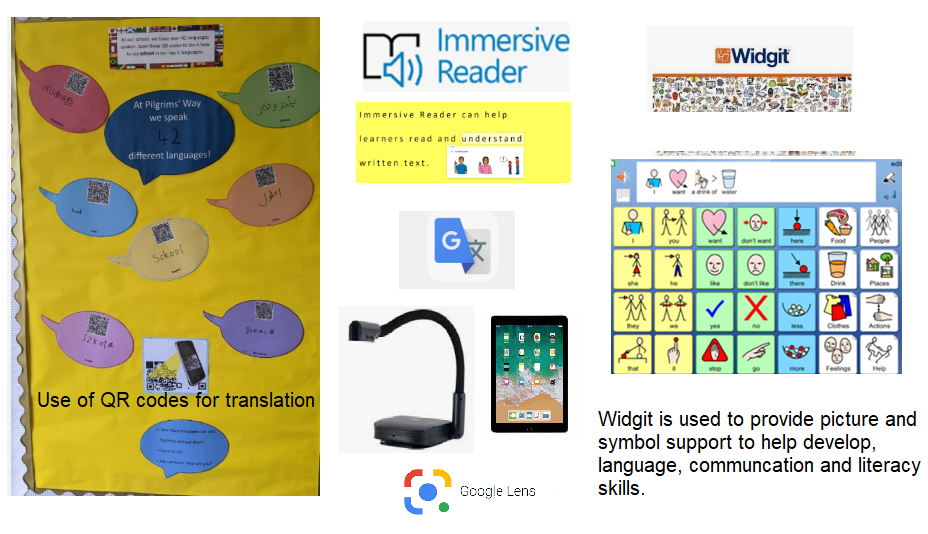
Pilgrims’ Way has been awarded an ‘Innovator’s in Assistive Technology’ badge. This means that staff have been recognised for embracing assistive technology (AT) to support teaching within everyday classroom practice. AT can help to remove barriers to learning, support learners to work more independently and allow them to demonstrate their knowledge, skills and understanding in different ways. For example, where a pupil may struggle to read independently, using a ‘text to speech’ feature lets them read any text they choose. Similarly, by using 'speech to text', a pupil is able to dictate what they want to write rather than having to type it. This has clear benefits for pupils who struggle with spelling, handwriting or keyboard skills. Translation tools are also used in every classroom practice to enhance language development by supporting learning in home language and English.
Here are some of the tools that we currently use in school:
Supporting children's emotional regulation
Regulation is key to having fun, completing tasks, working effectively with others, maintaining healthy and meaningful relationships, achieving and having an overall sense of well-being. It plays a huge role in finding success in school and in life.
Parents and Carers – What can you do to help?
All the adults working with children in school are trained in how to talk to children about feelings and to support emotional regulation. We encourage parents and carers to have these same discussions with children at home and to model your own feelings.
Stories about emotions
For younger children in school, we teach emotions using stories such as The Colour Monster or Daisy's Dragons. It is important for children to learn to identify and express a wide range of feelings, while also understanding that others have feelings, too.
Children are regularly encouraged to talk about how they are feeling and adults will offer to discuss feelings, particularly if the emotion is a big or negative one.
Language is modelled to children to help them describe and express how they are feeling which is such an important part of their emotional development.
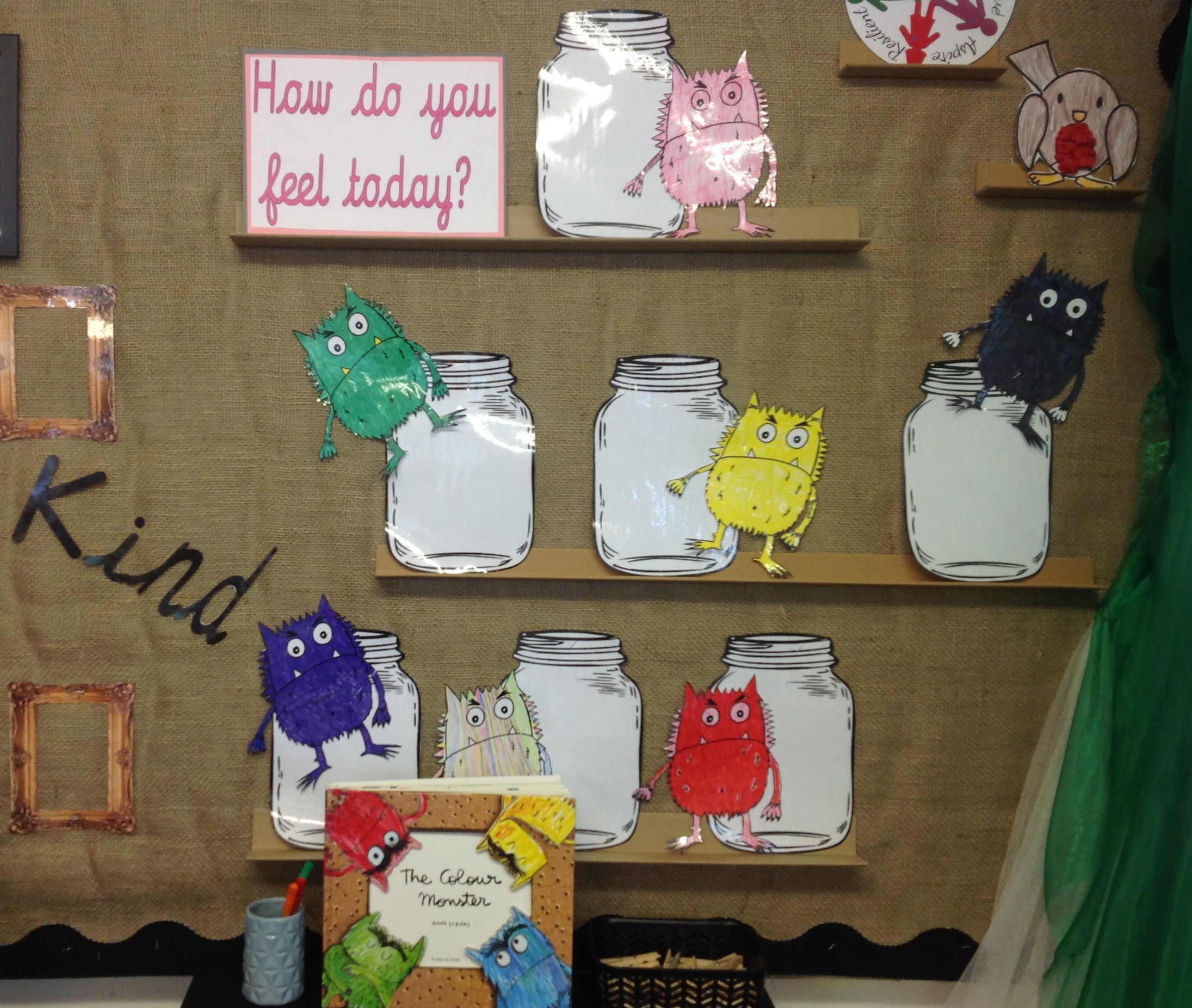
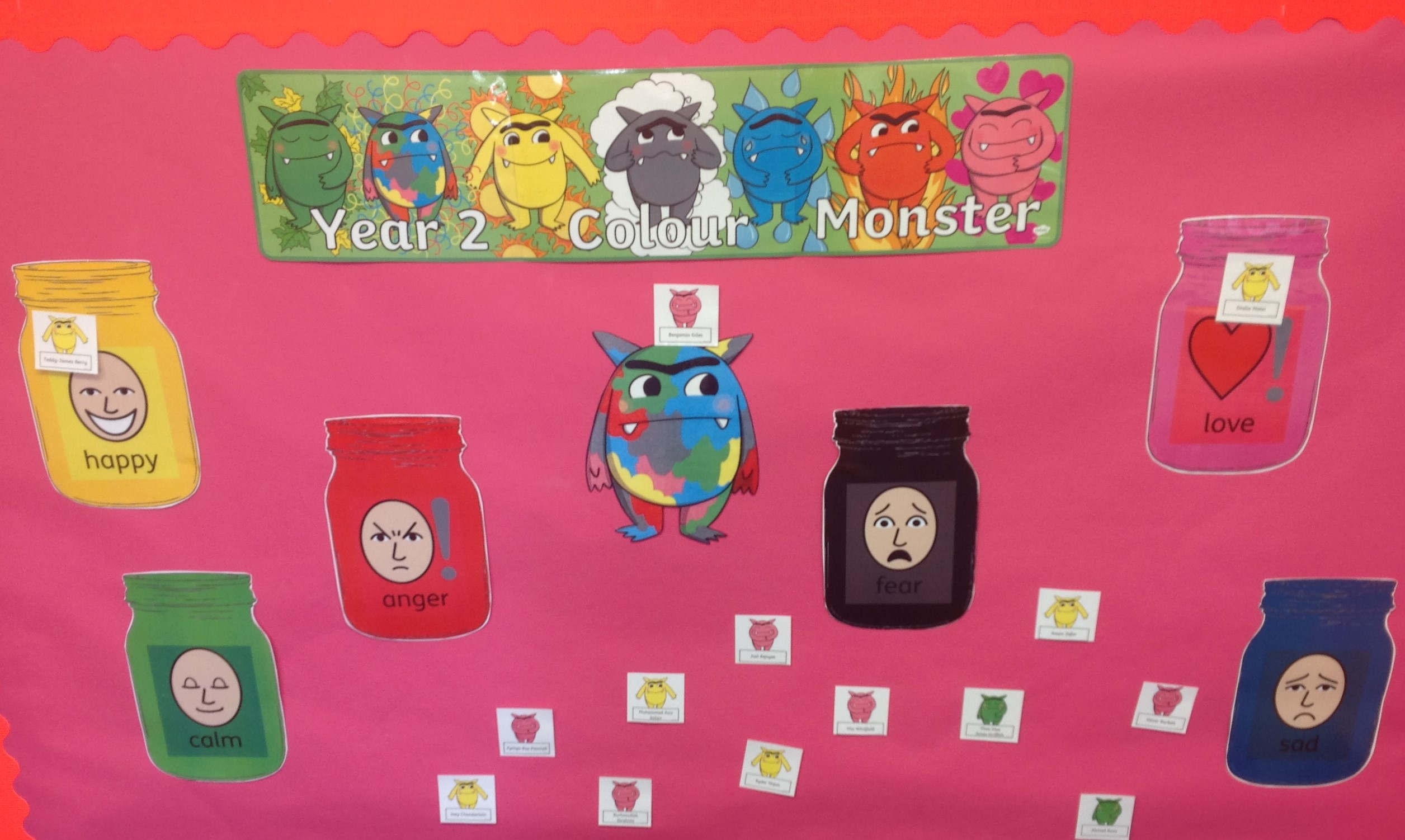
These links are for video clips of Colour Monster stories you may want to watch -
https://www.youtube.com/watch?v=IY6d1jyvmVg&t=14s The Colour Monster
https://www.youtube.com/watch?v=vj5V9tPY04Q&t=5s The Colour Monster goes to School
Zones of Regulation
For older children we teach emotions and regulation referring to the 'Zones of Regulation'. Using The Zones Check-In provides common language and a visual system to help pupils express how they are feeling in each of the Zones and what regulation tools they might need.
The Zones of Regulation framework categorises our emotions and energy states into four colour-coded Zones:
-
Blue (low energy such as sad or tired)
-
Green (neutral energy such as calm and focused)
-
Yellow (elevated energy such as frustrated or excited)
-
Red (highest energy such as angry or overjoyed).
Adults and children of all ages move through a wide range of emotions, energy, and alertness throughout the day. All feelings and Zones are a natural part of being human.
The Zones help children to learn that everyone experiences all types of feelings and emotions. The Zones are neutral and do not communicate judgement - No Zone is bad.
Adults comment aloud about their own energy and emotions. That way, the children know it is natural that we all experience the different zones and use strategies to self-regulate.
Children are praised for identifying their emotions. Children are encouraged to share the Zone they are in and what they need to do to be 'green'.
Adults show interest about the triggers and tools pupils use to move between them.

A Zones of Regulation display

A 'Zones board' for use by individual pupils at school and at home
A parents guide to Language through Colour
Language through Colour (LTC)
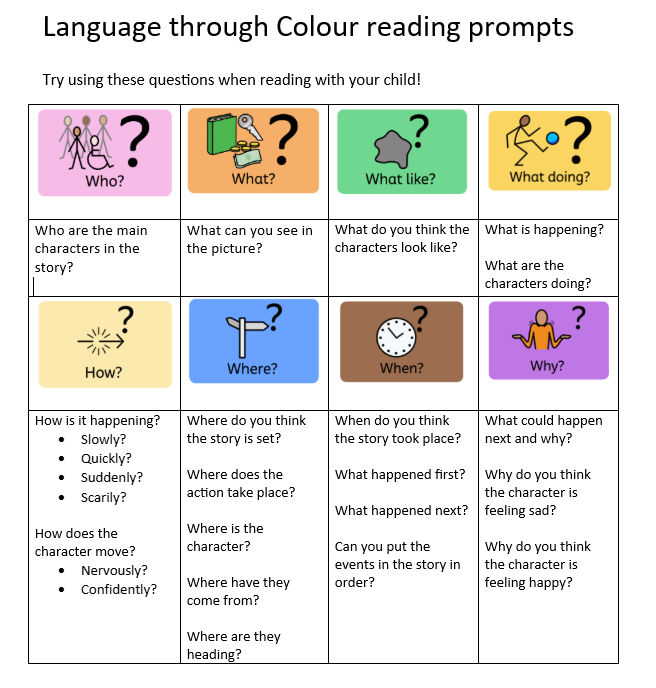
We wanted to share a learning approach we are using called Language through Colour (LTC). You may have heard your child(ren) talk about it and seen the vocabulary in colours on the Knowledge Organisers we share with you.
What is LTC?
LTC is an inclusive approach used across the school and throughout the curriculum to support children’s language development.
How does it work?
-
We use LTC as a framework for pupils to understand and make connections with their learning.
-
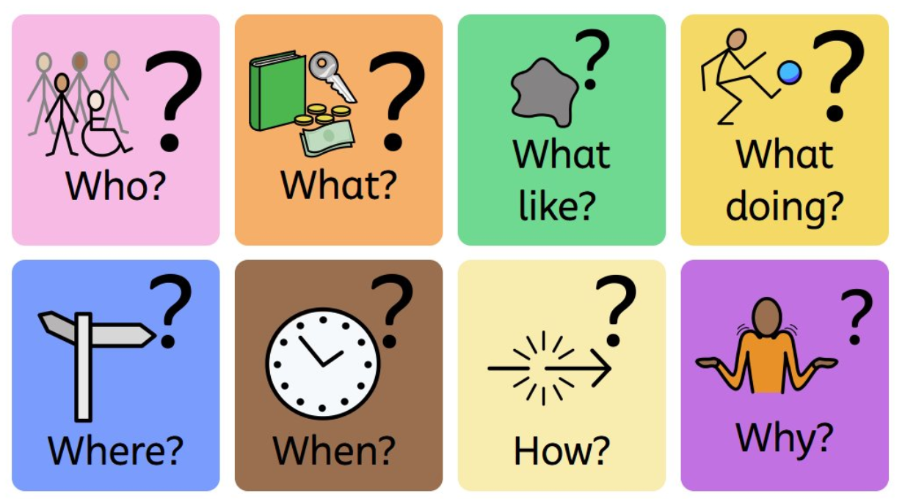
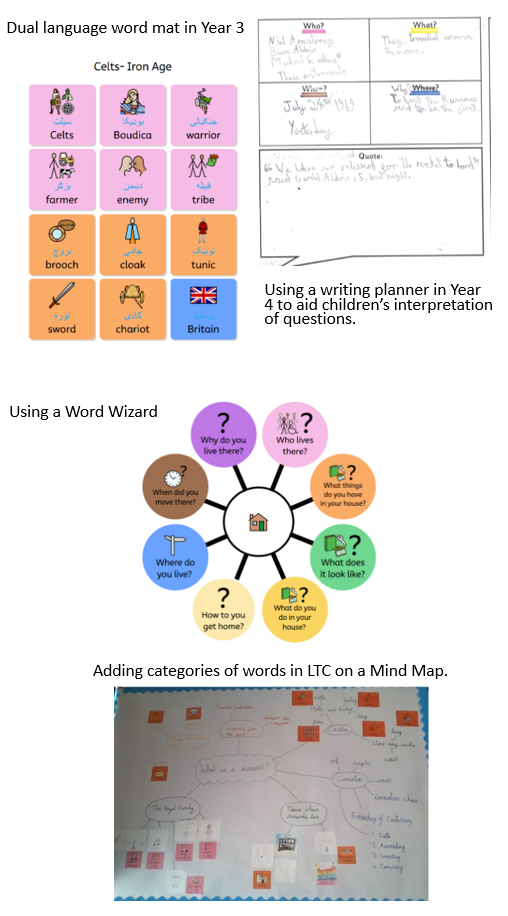
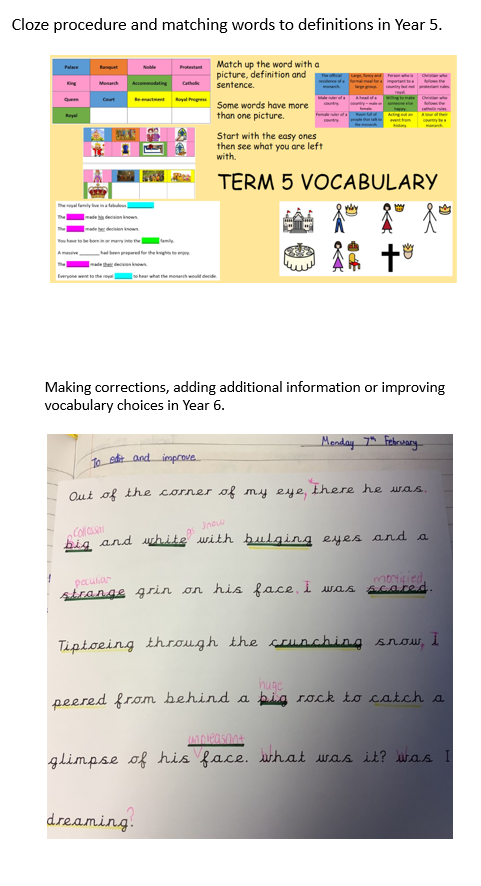
Categories of words or phrases are colour coded according to the type of information they convey (e.g. action, person, doing word etc).
-
Each category is also linked to a question.
How do we use LTC in the classroom?
-
To help pupils to understand word categories e.g. nouns, adjectives, verbs, adverbs etc
-
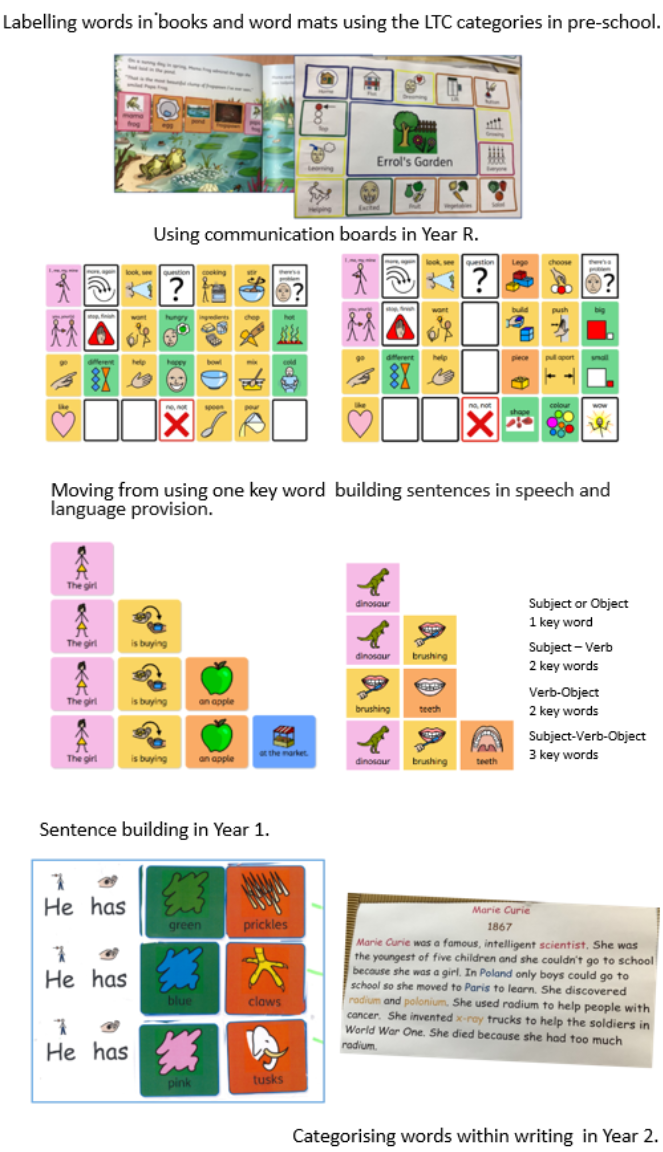
To help pupils to build sentences both orally and written. Pupils are given prompts for information needed and the order in which to place words.
-
To help pupils to understand questions and how to answer them appropriately.
-
To help pupils to identify keywords or pieces of information from stories/events/ displays on word walls.
-
To support pupils to self-assess, revisit, improve and extend their written work, e.g., 'I have not added enough green words describing words/adjectives'.
Examples of use across the school
How Language through Colour can be used at home to support reading